
Overview
Across the globe, countries and governments are seeking the best solution to driving safety policies, especially concerning elderly drivers.
Different policies were thus made, and here we compare them in the United States, Japan, and China.
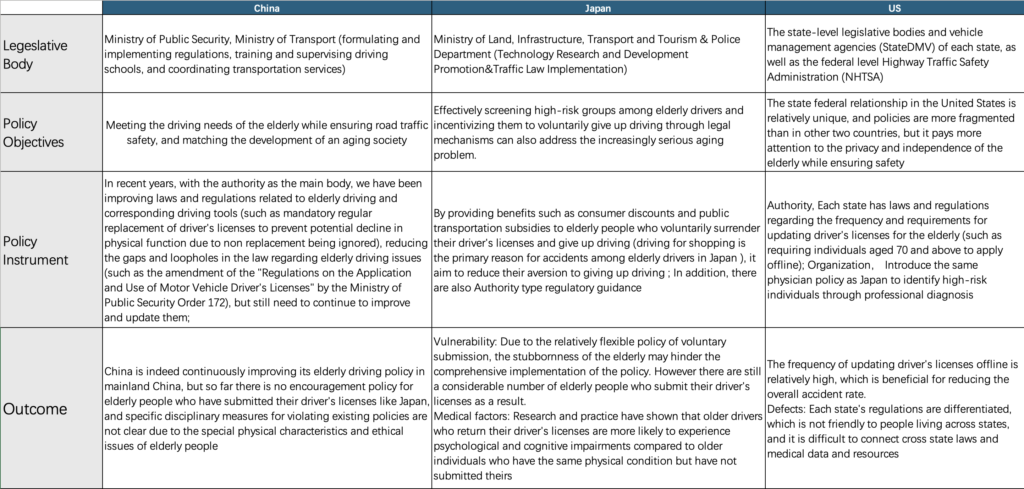
Here displays the final analysis of the policies of the three countries.
Policy Analysis
US: The biggest characteristic of the United States is the lack of a unified federal policy, with each state making its own decisions. So some states are very lenient towards the elderly, while others are very strict. The overall goal is actually similar to that of China and Japan, which is to pursue a balance between “safety” and “independent travel”. But each state in the United States emphasizes that age should not be the sole reason for imposing restrictions on individuals, and it depends on their actual abilities.
Their approach relies more on ‘ability assessment’. For example, some states require drivers over the age of 70 to update their driver’s license offline, and also check if you have any obvious problems or ask doctors to report patients who are not suitable for driving. This belongs to the policy of the ‘Organization’, relying on the cooperation of medical institutions and DMV (Vehicle Management Department). In addition, a few states also offer a free ID card to elderly people who voluntarily return their driver’s license, which can be considered a small financial incentive. The advantage of the United States in this regard is flexibility, as each state can adjust its rules according to its own population structure. But the problem also lies here: the same citizen can drive in this state, but moving to a neighboring state may not be possible, and the lack of unified rules creates difficulties across states. Another controversial point is that research has found that although elderly drivers are considered dangerous, data shows that young people actually have a higher proportion of fatal accidents. So one viewpoint is that some states in the United States are actually using moral anxiety instead of data decision-making.
China: China’s policy progress from banning driving for people over 70 years old to now lifting the ban on elderly driving reflects stricter physical examinations, with the goal of minimizing the deprivation of their right to drive while preventing accidents. This takes into account the reality that public transportation may not be convenient where many elderly people live. China mainly relies on regulations to control the entry and renewal process, such as requiring drivers over the age of 70 to submit a medical examination report every year, and adding the so-called “three skills” test: memory, judgment, and responsiveness. In terms of policy tools, the typical type is “Authority”, which means “the state stipulates what citizens must do”.
The flaw is that it only focuses on physical examinations and one-time “three force” tests, with almost no other supervision in between. For example, an elderly person who has undergone a physical examination this year may not have anyone to supervise them until they have an accident next year. Another loophole is the elderly mobility scooter, the “Old Man Le”, which is not within the scope of driver’s license management, but runs on the streets and has a high accident rate. This is almost a blind spot, and the country has just begun systematic management recently.
Japan: The aging population in Japan is more severe than in China, so the Japanese government’s policies are more detailed or “humanized” compared to existing domestic policies. The policy objective is not limited to preventing accidents involving elderly drivers, but also includes finding ways to encourage them to voluntarily give up driving. Because Japanese research has found that once elderly people are completely unable to drive, they can become very lonely and even have a higher risk of needing care. In addition to legal requirements (such as mandatory cognitive tests for those over 75 years old), Japan also has a way for elderly people to voluntarily return their driver’s license and enjoy discounts on public transportation, restaurants, and more. This is a typical ‘Treasure’ policy. In addition, Japan also encourages elderly drivers to post a “Four Leaf Clover” logo, which means “Elderly, please forgive me”. This is an informational tool and also more humane. From a data perspective, the “driver’s license refund system” has indeed led many elderly people to voluntarily give up driving, reducing the risk of accidents. But the side effects are also obvious: some elderly people living in rural or mountainous areas can hardly go out after losing their cars, and their social and medical conditions inevitably deteriorate. So to some extent, Japan’s approach is “trading freedom of travel for traffic safety”. And for those stubborn elderly people without obvious physical abnormalities, Japan has not yet had a particularly tough approach to deal with them.